Hazelnut Paste / Puree
100% hazelnut paste (puree) engineered for stable high-shear mixing, consistent flavor carry and repeatable depositor/pump performance — widely used in chocolate, fillings, spreads, wafers and frozen desserts.
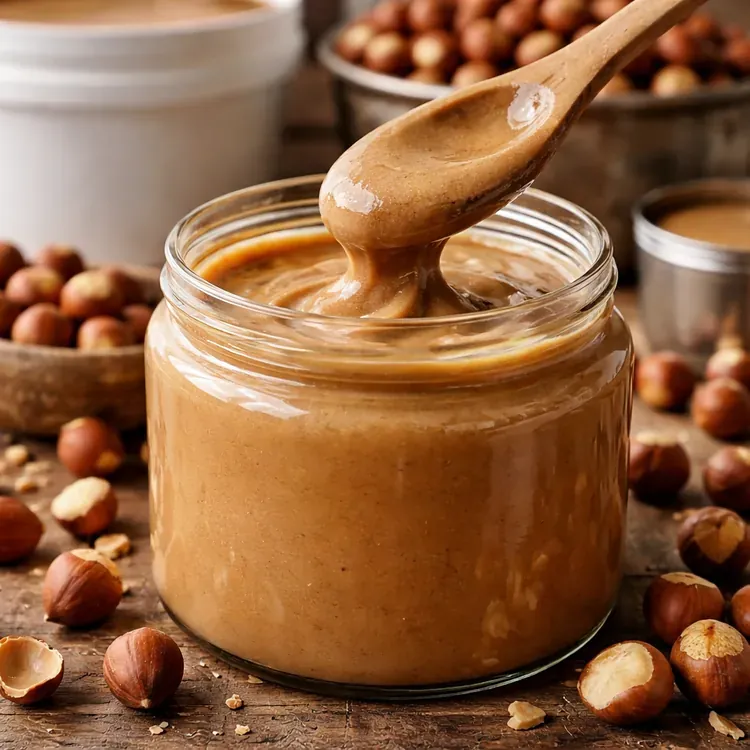
What this format is built for
Hazelnut paste (often called puree) is produced by roasting and finely milling hazelnuts into a homogeneous mass. Industrial buyers select paste when they need maximum flavor density, clean label (100% hazelnut), and stable dispersion in fat-based systems such as chocolate and creams.
- High-shear mixing stability: designed to disperse into cocoa butter, dairy fat, vegetable fats, and nut-fat systems.
- Controlled fineness: defined micron ranges to match mouthfeel and processing (pumping, injecting, depositing).
- Roast tuning: light/medium/dark roast for aroma and color alignment.
- Oxidation management: limits and packaging options set to your shelf-life target.
Share your internal paste spec (fineness, oxidation limits, micro limits, packaging format, destination) and we’ll map it to a stable, repeatable product definition.
Product variants we can supply
| Variant | What it is | Best for |
|---|---|---|
| 100% Hazelnut Paste / Puree | Pure hazelnut mass with no added sugar or emulsifiers; roast and fineness defined per program. | Chocolate, creams, fillings, bakery injectors, ice cream variegates, spreads base |
| Roast profiles | Light / medium / dark roast (and tuned in-between) to match aroma and color targets. | Brand-locked flavor profiles and consistent finished color |
| Fineness options | Typical industrial fineness ranges include 20–25 µm, 25–40 µm, 40–80 µm; other targets on request. | Mouthfeel control, pump/depositor compatibility, chocolate viscosity management |
| Praline paste (optional program) | Hazelnut paste blended with sugar to customer spec (sweetened “praline-style” ingredient). | Confectionery fillings, gelato bases, bakery creams where sweetness/body is desired |
Many Turkish producers use “hazelnut puree” and “hazelnut paste” interchangeably for 100% hazelnut mass. We lock the definition using: roast degree + fineness (µm) + oxidation/micro limits + packaging and storage requirements.
Technical specification framework
Typical paste/puree specification points
| Parameter | Typical options / targets | Why it matters |
|---|---|---|
| Ingredients | 100% hazelnut | Clean label; maximum flavor density and fat-phase compatibility |
| Roast degree | Light / medium / dark (tunable) | Controls aroma, bitterness balance and finished color |
| Fineness / particle size | 20–25 µm • 25–40 µm • 40–80 µm (or 20–80 µm upon request) | Defines mouthfeel, chocolate viscosity, pumpability and depositor performance |
| Appearance & texture | Homogeneous paste; typical hazelnut flavor; free from foreign odours | Reduces texture defects in fillings, creams and frozen dessert bases |
| Packaging program | 5–25 kg buckets • 20–220 kg drums/barrels • 1,000 kg IBC • bulk tanker | Optimizes handling, oxygen exposure, unloading method and cost |
Chemical & oxidation controls (typical contract fields)
The ranges below reflect common producer specification sheets for hazelnut paste. Final limits are aligned to your QA program and destination market rules.
| Parameter | Typical target / max | Notes |
|---|---|---|
| Moisture | ≤ 2% max | Lower moisture supports stability and reduces microbial risk |
| Fat content | ~55–68% (natural fat in paste) | Key driver of mouthfeel and fat-phase performance |
| Free Fatty Acids (FFA) | ≤ 1% max | Hydrolytic rancidity control |
| Peroxide value | ≤ 1.0 meq/kg max | Oxidative rancidity control |
| Aflatoxin B1 | ≤ 5 ppb max | Food safety; align to destination market |
| Total aflatoxin (B1+B2+G1+G2) | ≤ 10 ppb max | Food safety; align to destination market |
Microbiological controls (typical contract fields)
| Test | Typical limit | Notes |
|---|---|---|
| Total Plate Count | ≤ 2,000 / g | Lot-based monitoring |
| Mould & Yeast | ≤ 100 cfu / g | Moisture and storage are key drivers |
| Enterobacteriaceae | ≤ 100 cfu / g | Hygiene indicator |
| Total coliform | ≤ 10 cfu / g | Hygiene indicator |
| E. coli | Absent / g | Food safety requirement |
| Salmonella | Absent / 25 g | Food safety requirement |
Producers commonly reference Turkish standards for processed hazelnut products (e.g., hazelnut paste standards) or supply to customer specifications, and can provide program statements such as GMO-free / no irradiation / no nanotechnology where supported by producer documentation.
Packaging & logistics programs
Hazelnut paste is typically shipped in sealed industrial packaging formats that match your unloading method (manual scoop, pump-out, heated jacket, IBC discharge). Common formats include drums/barrels, buckets, IBCs and bulk tanker options.
| Format | Typical sizes | When to use |
|---|---|---|
| Plastic buckets | 10 / 12.5 / 15 / 20 / 25 kg (common) • 5 / 10 / 20 kg also used | Small–mid volume users, pilot lines, easier handling and partial use programs |
| Drums / barrels | 20 / 25 / 30 / 55 / 60 / 200 / 220 kg (varies by producer) | Standard industrial use; stable palletization for export |
| IBC | 1,000 kg | High volume users with dedicated discharge and reduced packaging waste |
| Bulk tanker / container | Bulk program by agreement | Large users with controlled unloading and dedicated QA programs |
A common reference shelf life is 12 months under cool storage (e.g., 10–15 °C) with controlled humidity. Final shelf life depends on roast profile, oxygen exposure, packaging selection, and your QA release limits.
For pump/depositor lines, paste behavior is typically stabilized by (1) selecting the correct fineness band, (2) managing temperature during use (to reduce viscosity spikes), and (3) minimizing air/oxygen pickup during rework and transfer. We can align packaging (bucket/drum/IBC/bulk) to your plant handling to reduce oil separation and texture drift.
Where it’s used
Industrial hazelnut paste/puree is widely used in chocolate, bakery and frozen dessert applications. Typical usage includes chocolate, bakery, biscuits, wafers and ice cream.
| Category | Applications | What paste delivers |
|---|---|---|
| Chocolate & confectionery | Chocolate flavor base, gianduja-style systems, praline/filling bases, compound coatings | Strong nut flavor, richness, protein contribution; can influence melt and mouthfeel |
| Bakery, biscuits & wafers | Cream fillings, wafer creams, injected pastries, croissant fillings, cookie inclusions | Homogeneous texture, stable dispersion and predictable depositor behavior |
| Ice cream & frozen desserts | Variegates, gelato bases, ripple fillings, inclusions systems | Flavor density without added water; smooth mouthfeel tuned via fineness |
| Spreads & creams | Hazelnut creams/spreads, nut butter-style products, flavored dairy and dessert creams | Clean-label “nut base” enabling flexible sweetener/fat/emulsifier design |
For most industrial RFQs, the three “must-lock” parameters are roast degree (color/aroma), fineness band (µm), and oxidation limits (peroxide/FFA) at ship date. Packaging choice (bucket/drum/IBC/bulk) is then selected to protect those targets through your logistics and storage.
Quality, safety and consistency
We coordinate with established Turkish processors to deliver repeatable paste performance lot-to-lot, with documentation and sampling aligned to your procurement SOP. On the producer side, common industrial controls include optical/laser sorting, X-ray, sortex, sieving, metal detectors and magnets, supported by GMP and HACCP programs.
- Lot-based traceability: lot IDs, best-before, origin and standard markings on industrial packaging
- COA fields: moisture, peroxide, FFA, aflatoxins and micro limits aligned to your acceptance plan
- Process controls: sorting/foreign matter reduction and metal detection prior to pack-out
FAQ
Can you align viscosity for dosing and pumping?
Yes. In practice, paste “viscosity” is managed by selecting the correct fineness band (µm), controlling temperature during use, and matching packaging/unloading to your equipment. We can align product definition and COA fields to your line requirements.
Is the paste suitable for fillings and variegates?
Yes. Hazelnut paste/puree is widely used in fillings, creams/spreads, wafers and frozen dessert systems (including variegates).
Do you offer roasted paste?
Yes. Roast profile can be supplied as light, medium or dark (and tuned in-between) to match your aroma and color targets.
What fineness options are available?
Common industrial targets include 20–25 µm, 25–40 µm and 40–80 µm (or 20–80 µm on request), selected based on mouthfeel and process behavior.
What packaging formats do you support?
Typical formats include plastic buckets (5–25 kg), drums/barrels (20–220 kg), 1,000 kg IBCs and bulk tanker programs depending on volume and handling.
Request a specification & quote
Tell us your roast target (light/medium/dark), fineness (e.g., 25–40 µm), oxidation limits (peroxide/FFA), micro limits, quantity and destination. We’ll respond with a spec-aligned offer and packaging program (bucket/drum/IBC/bulk).
Buyer specification checklist
For a practical quotation, identify the intended application and confirm roast profile, particle-size target, viscosity or pumping needs, and packaging format. Include target quantity, delivery destination, incoterm and any buyer-approved specification document. Published reference ranges are not a substitute for the final agreed lot specification and certificate of analysis (COA).
Hazelnut Paste / Puree · Trade references
| Botanical name | Corylus avellana |
|---|
Have the importer confirm the destination tariff line using the processing method and ingredient list. Roasting, grinding, added sugar and blending can change classification.